
Carbohydrate counting, insulin matching and exercise, without unnecessary dietary restriction.
We commonly see people who were taught carbohydrate counting at diagnosis, in some cases many years earlier, and whose insulin-to-carbohydrate ratios and portion estimation have not been reviewed since. Glucose readings are unpredictable despite considerable effort.
We also see people whose glucose is reasonably stable at rest but not around exercise, with hypoglycaemia during or following aerobic training, or unexpected elevation with high-intensity work, leading some to reduce or avoid exercise altogether.
Others present with postprandial elevation that carbohydrate counting alone has not resolved, particularly following meals high in fat and protein.
Many also have continuous glucose monitoring data that they are uncertain how to interpret or act upon.
Nutritional management of type 1 diabetes is concerned with matching insulin accurately to intake, rather than with dietary restriction. Accurate dose-matching allows dietary flexibility to be maintained while improving glycaemic stability. These are technical skills, and they can be taught or refined at any point after diagnosis.
Carbohydrate counting, formally reviewed. Carbohydrate counting with insulin dose adjustment is the established approach, and meta-analysis demonstrates lower HbA1c compared with general dietary advice. In most people presenting to us, it has not been reviewed since diagnosis. Portion estimation, insulin-to-carbohydrate ratios across different meals and times of day, and correction factors are all reassessed.
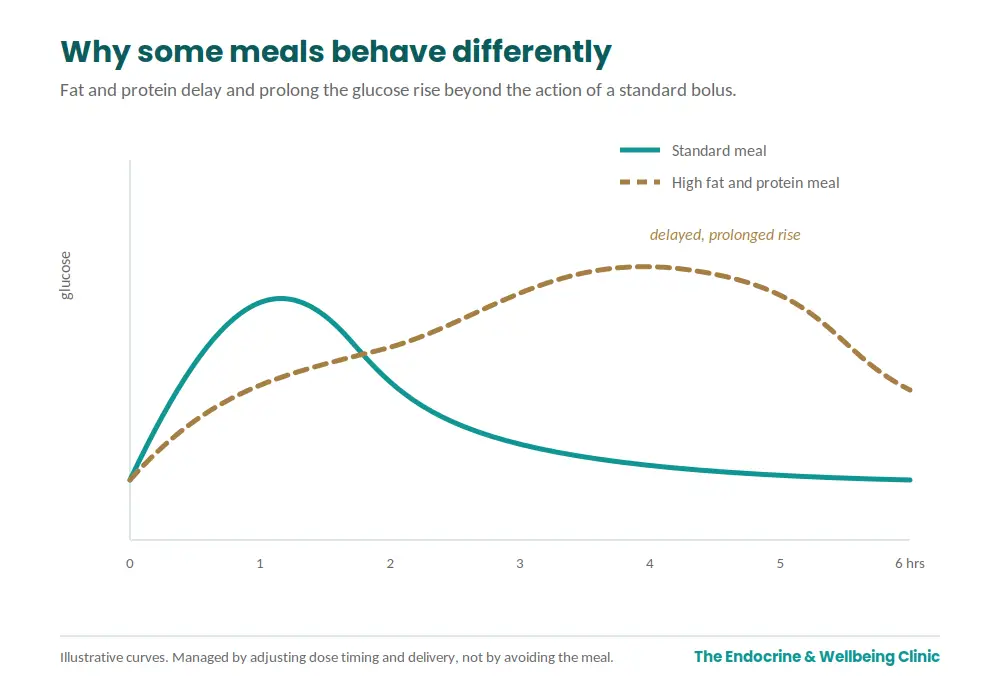
Fat and protein, in addition to carbohydrate. Meals high in fat and protein delay and prolong the postprandial glucose rise, which explains persistent elevation following an accurately counted meal. Counting fat and protein alongside carbohydrate is associated with improved glycaemic control, and split or extended bolus strategies address the delayed rise directly.

Exercise and hypoglycaemia prevention. Different forms of exercise affect glucose in different directions: sustained aerobic exercise typically lowers it, while high-intensity and resistance exercise may raise it. Specific strategies for carbohydrate intake and insulin adjustment before, during and after exercise are developed, so that training becomes predictable.
Interpretation of continuous glucose monitoring data. Glucose traces are reviewed alongside recorded intake, which typically identifies the responsible pattern — a consistently mistimed bolus, an inaccurate ratio at a particular meal, or overnight drift. Dr Isobelle Smith manages insulin regimens and diabetes technology alongside this.
Lower-carbohydrate approaches can reduce glycaemic variability and insulin requirements, and some people with type 1 diabetes manage well on them. They also carry specific considerations: hypoglycaemia risk during insulin adjustment, ketone monitoring, nutritional adequacy, and particular caution for those undertaking substantial training, those who are growing, and those who are pregnant or planning pregnancy. This is not an approach to undertake without supervision. Where you wish to pursue it, it is undertaken with us and with your treating specialist rather than managed independently.
No. Type 1 diabetes is managed by matching insulin to intake rather than by excluding foods. The objective is accurate dose-matching so that dietary restriction is minimised.
Fat and protein delay gastric emptying and prolong the glucose rise beyond the action profile of a standard bolus. This is managed by adjusting the timing and delivery of the dose rather than by avoiding the meal.
Through a strategy specific to the type, timing and intensity of the exercise, generally combining carbohydrate intake with insulin adjustment beforehand. This is established at assessment and refined against your own glucose data.
Nutritional management and dose-matching strategies are within our scope. Any change to your insulin regimen is made with Dr Smith or your treating specialist, with whom we work directly.
No referral is required to book. As type 1 diabetes is a chronic condition, your general practitioner may be able to refer you under a chronic disease management plan for a Medicare rebate.
The Endocrine & Wellbeing Clinic
Phone: (02) 9870 3256
Locations: Balmain (inner west Sydney) and Telehealth Australia-wide
Affiliated with: Dietitians Australia, Australian Diabetes Society, Endocrine Society of Australia
This page is not a substitute for individual medical advice. Book a consult for assessment specific to your situation.
All future appointments will be at 100 Elliott Street Balmain 2041