Nutritional management for PMOS, endometriosis and preconception care.
We commonly see women with Polyendocrine Metabolic Ovarian Syndrome (PMOS, formerly PCOS) who have been advised to lose weight without further specific guidance, and who are seeking a defined explanation of what to change and why.
We also see women with endometriosis whose gastrointestinal symptoms — bloating, abdominal pain and altered bowel habit — are as disruptive as their pelvic pain, and who have attempted unsupervised elimination diets without sustained improvement.
Others are preparing for pregnancy or fertility treatment and wish to establish which interventions are supported by evidence.
Many have also been recommended supplements on the basis of confident claims and are seeking an assessment of which are supported.

Nutrition has a defined role in PMOS, endometriosis and preconception care. That role is specific rather than general, and a considerable proportion of the dietary advice promoted in this area is not supported by evidence. We work from the available evidence and are explicit about its limits.
Insulin resistance in PMOS. Insulin resistance underlies many features of PMOS, including irregular cycles and elevated androgens. Mediterranean-style dietary patterns improve insulin sensitivity and cardiometabolic markers, and modest weight loss, where relevant, can restore ovulation. No single dietary pattern has been established as superior, so the pattern is constructed around what is sustainable for the individual.
Assessment of supplements. Coenzyme Q10 has the most consistent supporting evidence in PMOS: meta-analysis of nine randomised controlled trials involving 1,021 participants reports improvements in insulin resistance, fasting insulin and fasting glucose, reduced testosterone, and improved lipid profile, with no adverse effects identified in the trial reporting them. Vitamin D status warrants measurement, with correction where deficiency is identified; trial evidence for supplementation beyond correcting deficiency is mixed. Meta-analysis of mineral supplementation in PMOS, including zinc, reports reductions in fasting glucose, fasting insulin and insulin resistance, together with reductions in total cholesterol and triglycerides. Omega-3 fatty acids have supporting evidence for triglycerides and inflammatory markers, with less consistent findings for insulin sensitivity. Each is assessed against your blood results and dietary intake rather than recommended by default, and the majority of other supplements marketed for these conditions have limited supporting evidence.
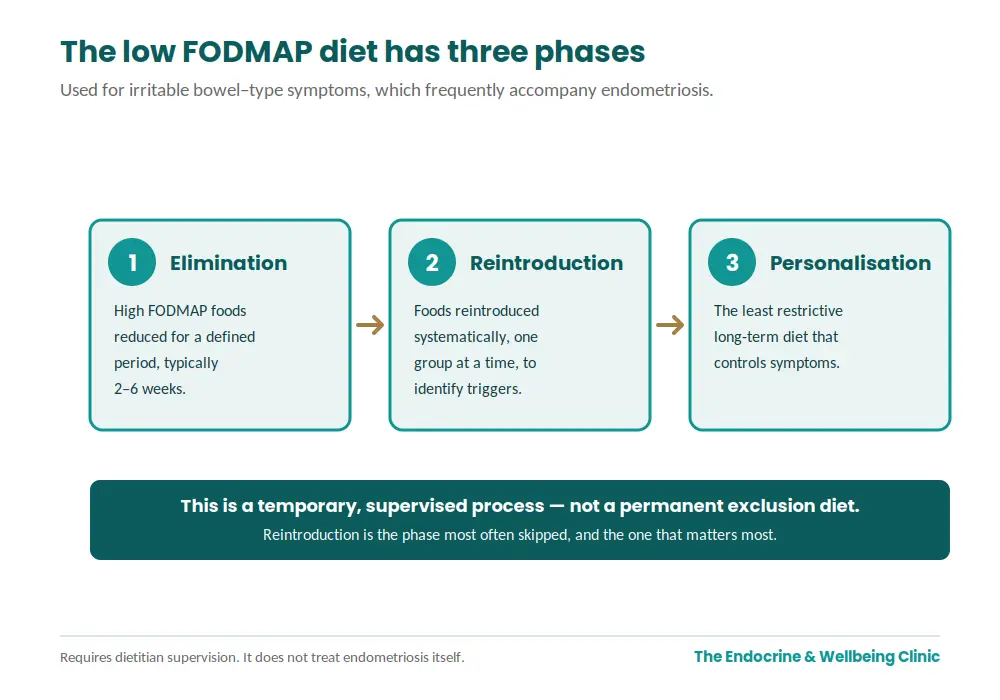
Gastrointestinal symptoms in endometriosis. Bowel symptoms in endometriosis frequently overlap with irritable bowel syndrome. A low FODMAP diet has substantial evidence for irritable bowel syndrome and is recommended in current guidelines, but it is a structured three-phase process requiring dietitian supervision rather than a permanent exclusion diet. Conducted correctly, it identifies individual triggers and reintroduces tolerated foods.
Preconception nutrition. The relevant priorities before pregnancy are well established: adequacy of folate, iodine and vitamin D, iron and vitamin B12 status, food safety, and glycaemic control where applicable. Dr Isobelle Smith manages the endocrine and metabolic components, including thyroid function and diabetes in pregnancy.
Extensive lists of foods to avoid circulate widely in relation to both PMOS and endometriosis, and the majority are not supported by evidence. Unnecessary restriction also carries a cost: it reduces dietary variety, may create nutritional deficits at the point where adequacy is most important, and increases the burden associated with eating. Where an elimination approach is genuinely indicated, as with a low FODMAP diet for irritable bowel–type symptoms, it is a structured, temporary and supervised process incorporating a planned reintroduction phase.
No single dietary pattern has been established as optimal. Mediterranean-style patterns have the strongest evidence for improving insulin sensitivity and cardiometabolic markers. Sustainability for the individual is the more important consideration.
Possibly, but selectively and based on assessment rather than by default. Coenzyme Q10 has the most consistent evidence, with meta-analysis reporting improved insulin resistance, reduced testosterone and improved lipids. Vitamin D warrants measurement and correction where deficient. Mineral supplementation including zinc has meta-analytic evidence for markers of insulin resistance and lipids, and omega-3 fatty acids have evidence for triglycerides. Most other supplements marketed for PMOS have limited supporting evidence, and we will say so.
It may assist the gastrointestinal symptoms that frequently accompany endometriosis, but it does not treat the endometriosis itself. It requires a supervised three-phase process incorporating reintroduction rather than long-term exclusion.
Not necessarily; this depends on the individual presentation. Where insulin resistance and excess weight are contributing to anovulation, modest weight loss may assist. This is a clinical judgement rather than a general rule.
No referral is required to book. If you have a chronic condition such as PMOS, your general practitioner may be able to refer you under a chronic disease management plan for a Medicare rebate.
The Endocrine & Wellbeing Clinic
Phone: (02) 9870 3256
Locations: Balmain (inner west Sydney) and Telehealth Australia-wide
Affiliated with: Dietitians Australia, Endocrine Society of Australia
This page is not a substitute for individual medical advice. Book a consult for assessment specific to your situation.