
Nutritional management that preserves lean mass and nutritional adequacy — and treatment for binge eating disorder, which is often the reason previous attempts have failed.
We commonly see people who have lost and regained weight repeatedly and are seeking an approach other than a further cycle of the same.
We also see people commencing or already taking a GLP-1 medication whose dietary intake has reduced substantially, who are uncertain whether that intake remains nutritionally adequate, or who have noticed a decline in strength and energy.
Others have been advised to lose weight for a specific clinical reason — planned joint replacement surgery, fertility treatment, hepatic steatosis, obstructive sleep apnoea or hypertension — and require a plan directed at that objective.
Many have received conflicting advice, or have a history of restrictive dieting that has complicated their relationship with food.
Body weight is influenced by metabolic, endocrine, pharmacological and behavioural factors. The relevant clinical question is not how weight can be reduced most rapidly, but how fat mass can be reduced while preserving lean mass, nutritional adequacy and a sustainable relationship with food, since these determine whether a result is maintained.
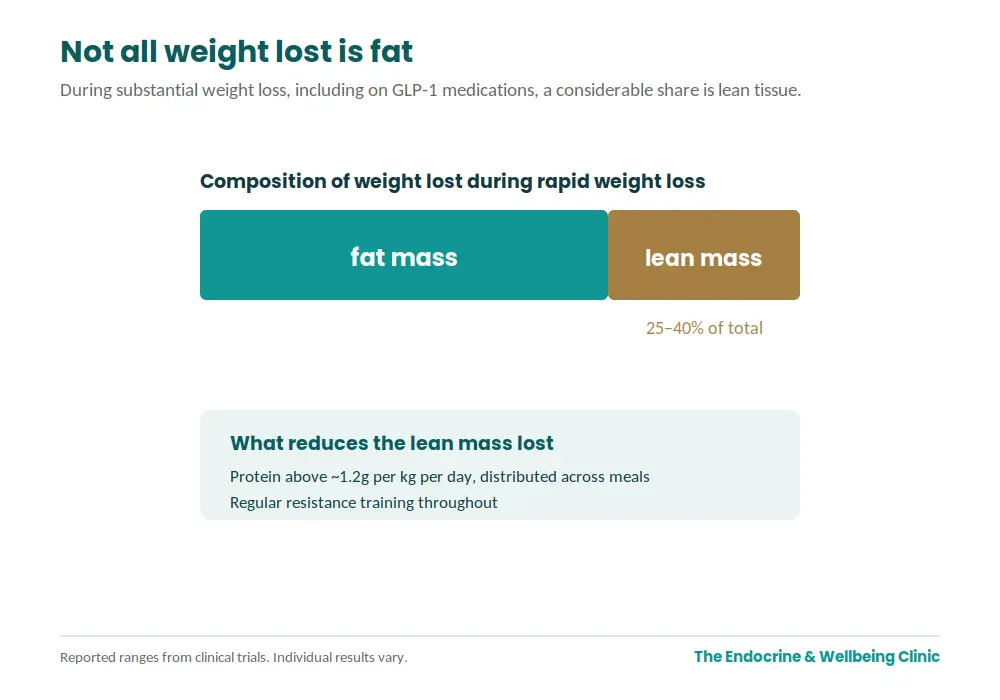
1. Preservation of lean mass during weight loss. During rapid weight loss, including that achieved with GLP-1 medications, a substantial proportion of the mass lost is lean tissue. Protein intake above approximately 1.2g per kilogram per day, distributed across meals rather than concentrated in one, combined with resistance training, has the strongest supporting evidence. Jessica Coombe (AEP) provides the resistance training component.
2. Nutritional adequacy at reduced intake. Where appetite is markedly reduced, total intake may fall below requirements for protein, fibre, calcium, iron and vitamin B12 without producing obvious symptoms. Adequacy is assessed directly rather than assumed, and the plan adjusted so that requirements are met within the reduced intake.

3. Management of medication-related symptoms. Nausea, reflux and constipation are common with GLP-1 medications and are among the principal reasons for discontinuation. Meal size, timing and composition, together with fibre and fluid intake, produce measurable improvement in most cases.
4. Screening for binge eating and disordered eating. A history of dietary restriction, repeated cycles of loss and regain, or distress associated with food alters what constitutes appropriate treatment. Every assessment includes a brief screen for binge eating, and where it is identified, it is treated as set out below rather than by applying a further restrictive plan.
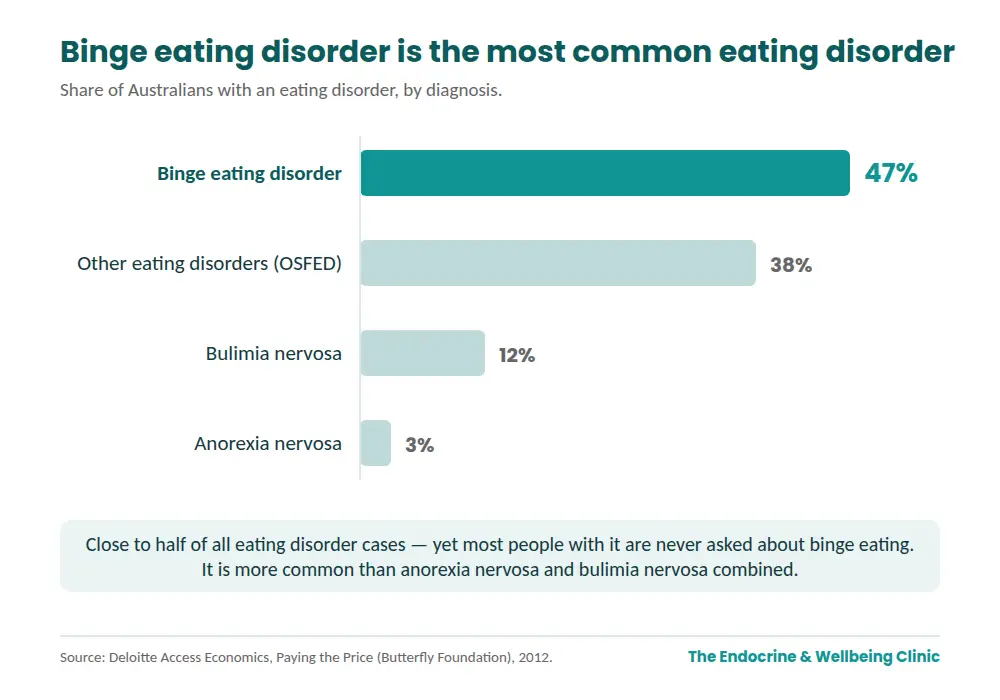
Many patients have never been asked about binge eating, and do not know it is a medical condition. Binge eating disorder is eating a large amount of food in a short time with a sense of losing control — usually in private, usually followed by guilt — at least once a week, without the vomiting or purging seen in bulimia. It is the most common eating disorder in Australia, accounting for close to half of all cases (Deloitte Access Economics, 2012), and people with the condition are three to six times more likely to have obesity (Abbott et al., 2018).
It is not a lack of willpower. Dieting produces the restriction that drives the next binge, which is why repeated weight loss attempts have failed. Most people with the condition present for weight, fatty liver or type 2 diabetes and are managed for those without the binge eating ever being named. It is treatable.
Where binge eating disorder is present, it is treated before or alongside weight management. Treatment establishes regular eating — three meals and two to three snacks with no more than three to four hours between them — which is the foundation of enhanced cognitive behaviour therapy (CBT-E) and reliably reduces binge frequency (Fairburn, 2008), and then dismantles the dietary rules that maintain the cycle. A food and symptom record is used at each session. Weight loss is not the aim of binge eating disorder treatment; it is a frequent consequence of stopping the binges.
Isabelle (Belle) Smith works alongside the patient’s psychologist where one is involved, and alongside the clinic’s endocrinologists for the metabolic conditions — type 2 diabetes, fatty liver, high cholesterol — that so often sit with it, so the eating disorder and the metabolic condition are treated together rather than in separate practices.
Patients with a diagnosed eating disorder are treated under the Medicare Eating Disorder Plan, which provides up to 20 dietetic sessions in 12 months rather than the five available under a chronic condition plan. Where the patient also has a chronic condition such as type 2 diabetes or fatty liver, a chronic condition management plan can be prepared in addition, and its five sessions used with our exercise physiologist, Jessica Coombe (AEP), so that dietetic and exercise treatment run together.
These medications are effective, and this page is not intended to discourage their use. What they do not determine is dietary composition. Appetite suppression makes weight loss more readily achieved and also makes inadequate protein intake, avoidable loss of lean mass and nutritional inadequacy more likely — the combination that leaves a person weaker rather than healthier at a lower body weight. Nutritional management and resistance training determine the composition of the weight lost, not merely its magnitude. We work with patients taking these medications, discontinuing them, or not using them at all.
Patients with obesity who binge eat may meet the criteria for an Eating Disorder Treatment and Management Plan, which provides up to 20 dietetic sessions (MBS item 82350) in 12 months rather than the five available under a GP Chronic Condition Management Plan. Eligibility for binge eating disorder is an EDE-Q score of 3 or more, binge eating at least three times per week, and two or more of: current or high risk of medical complications, a serious comorbid medical or psychological condition, a hospital admission for the eating disorder in the past 12 months, or an inadequate response to treatment over the past six months. A comorbid condition such as type 2 diabetes or fatty liver will often satisfy the third criterion. The plan (MBS items 90250 to 90253) is billed in addition to, and can be used alongside, a GPCCMP (item 965) for the chronic condition. Refer via HealthLink (EDI endwelcl), fax 02 7241 7040 or admin@endocrinewell.com.au.
Yes. Binge eating disorder is a recognised eating disorder with its own diagnostic criteria and its own Medicare treatment plan. If you regularly eat large amounts with a sense of loss of control, and feel distressed about it afterwards, it is worth raising at assessment — it changes how we treat you, and a weight loss diet on its own will make it worse.
Some lean mass is lost during any substantial weight loss, and it can represent a considerable proportion of the total. Adequate protein intake distributed across the day, together with regular resistance training, reduces this, which is why both are addressed.
More than general population recommendations. Evidence supports intake above approximately 1.2g per kilogram per day during active weight loss, distributed across meals. A specific target is determined at assessment.
Yes. These are common reasons for discontinuation, and meal size, timing and composition, together with fibre and fluid intake, produce measurable improvement in most cases.
Tell us at assessment. Binge eating disorder is treated at the clinic, and where it is present it is addressed first, because a restrictive weight loss approach makes it worse. If you meet the criteria for an Eating Disorder Plan, your GP can refer you for up to 20 Medicare-rebated dietetic sessions in 12 months, which can run alongside a chronic condition management plan for a condition such as type 2 diabetes or fatty liver.
No referral is required to book. If you have a chronic condition, your general practitioner may be able to refer you under a chronic condition management plan for a Medicare rebate, and if you meet the criteria for an Eating Disorder Plan, for up to 20 dietetic sessions.
The Endocrine & Wellbeing Clinic
Phone: (02) 9870 3256
Locations: Balmain (inner west Sydney) and Telehealth Australia-wide
Affiliated with: Dietitians Australia, Endocrine Society of Australia
This page is not a substitute for individual medical advice. Book a consult for assessment specific to your situation.