Protecting the muscle and metabolism that decide whether the result lasts.
Jessica Coombe (AEP) prescribes exercise as part of a treatment plan, working alongside your endocrinologist and dietitian — including programs timed to GLP-1 medications such as Ozempic, Wegovy and Mounjaro.
Most patients who come in to talk about weight loss are not people who have not tried. They have dieted, exercised, watched the number come back, and are now asking what is actually going on in their body.
For patients on a GLP-1, the question is usually the same one. The weight is coming off — but they have heard about muscle loss, and want to know what is happening underneath the scale, and what to do about it before they come off the medication.
We also see patients managing insulin resistance, pre-diabetes, type 2 diabetes or Polyendocrine Metabolic Ovarian Syndrome (PMOS, formerly PCOS) whose clinician has recommended weight loss, and patients returning to exercise after a period of weight gain or inactivity.
What most have not had is a specific, structured resistance training program — supervised, timed to the medication, and coordinated with the endocrinologist managing the dose.

Most weight loss plans stop at “eat less, move more”. The missing piece is what happens to muscle. When you lose weight you lose muscle along with fat — on GLP-1 medications, body composition studies show roughly a quarter of the weight lost is lean mass rather than fat. Treatment targets that directly.
Resistance training to preserve muscle. Progressive resistance training is the specific stimulus that preserves lean muscle while the rest of the body composition changes. Programs are centred on strength training — typically two to three supervised sessions per week, progressed as you adapt. This is what protects your metabolism while the weight comes off.
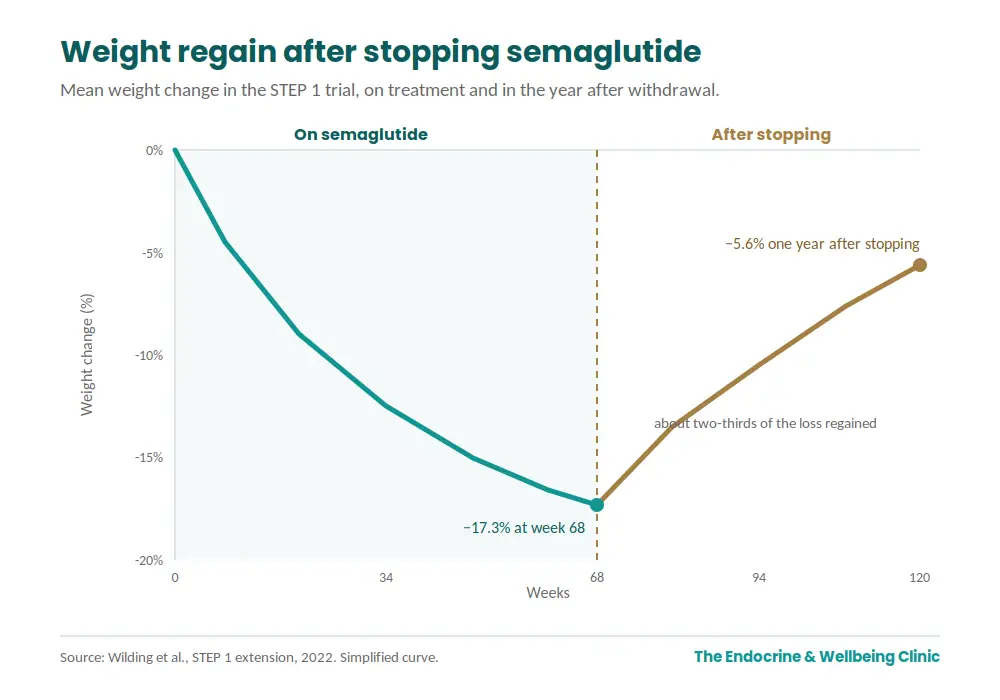
Why muscle decides whether the result lasts. Muscle is metabolically active tissue — your body uses energy to maintain it, even at rest. When muscle is lost during weight loss, your daily energy requirement falls, and if intake does not adjust, the excess is stored as fat. In the STEP 1 trial, participants regained about two-thirds of the weight they had lost within a year of stopping semaglutide; the SURMOUNT-1 study on tirzepatide showed similar body composition outcomes.
Programs that adjust as your body changes. The program is developed from your medical history, current medications, recent blood tests and exercise history, then adjusted as your weight, blood tests and medications change — including the transition off a GLP-1, when preserving muscle matters most.
Coordination with your endocrinologist and dietitian. Programs are coordinated with the treating endocrinologist — such as Dr Isobelle Smith — so medication changes, blood test changes and exercise changes are reviewed together. Where eating habits are part of the picture, our dietitian Isabelle (Bell) Smith works alongside.
Every program is tailored to you — your goals, injury, symptoms and stage of recovery. What treatment looks like is decided at assessment, not before.
Your initial 60-minute assessment includes a detailed history, review of any relevant scans, discussion of your goals, and a movement assessment to identify the factors contributing to your condition. From there, a personalised exercise program is developed and taught with a strong focus on correct technique and long-term recovery.
Depending on your needs, treatment may include one-on-one sessions, small supervised group classes, a home exercise program, or a combination of these. Your program is reviewed and progressed regularly — based on your symptoms, movement quality, strength and functional goals — to return you safely to the activities that matter most.
Nothing on this page is intended to discourage the use of GLP-1 medications — they are effective treatments, and for many patients the right ones. What the medication does not do is choose where the weight comes from. Without a loading stimulus, a meaningful share of what is lost is muscle, and that loss is what makes regain after stopping more likely. Resistance training alongside the medication is how the result is protected.
Yes. Resistance training before and during treatment protects muscle from the beginning, which is easier than rebuilding it later. If you are already on a GLP-1, it is not too late — starting resistance training now still reduces the proportion of muscle lost.
Body composition changes take weeks to show on the scale. Improvements in strength, energy and glycaemic control usually come earlier. The muscle-preservation work is a long-term investment rather than a quick change.
The first assessment is in person. Ongoing sessions can be supervised in person or, depending on your situation, supported remotely. Home-based programs can be effective when appropriately prescribed and progressed.
Exercise physiology is covered by most Australian private health funds under extras cover. Our reception team can help you check your cover.
No referral is required to book. If you have a chronic condition such as type 2 diabetes, your general practitioner may be able to refer you under a chronic disease management plan for a Medicare rebate.
The Endocrine & Wellbeing Clinic
Phone: (02) 9870 3256
Locations: Balmain (inner west Sydney) and Telehealth Australia-wide
Affiliated with: ESSA (Exercise and Sports Science Australia), ANZBMS, Endocrine Society of Australia
This page is not a substitute for individual medical advice. Book a consult for assessment specific to your situation.