
Fuelling, race nutrition and energy availability, matched to your training load.
Isabelle (Bell) Smith is an Accredited Practising Dietitian and Accredited Sports Dietitian, working with athletes from recreational runners through to elite sport.
We commonly see runners who are completing their training but not seeing the expected improvement in performance, with persistent fatigue between sessions and a decline in the quality of later intervals or the second half of long runs.
We also see runners whose difficulties occur in competition rather than training, typically presenting as gastrointestinal symptoms, cramping or a marked decline in pace beyond two hours. In most cases a fuelling strategy has not been rehearsed in training, and carbohydrate intake during the event is well below the recommended range for the distance.
Others are referred by their endocrinologist or general practitioner following a bone stress injury, menstrual disturbance, iron deficiency or reduced bone density — findings that may indicate inadequate energy intake relative to training load.
A frequent pattern is a well-structured training program accompanied by an unstructured approach to nutrition.

Endurance performance is determined primarily by training and the adaptation that follows it. Nutrition determines whether that training can be completed at the required quality, whether the athlete adapts and recovers between sessions, and how the athlete performs on the day. Two issues account for most presentations: total energy intake insufficient for the training load, and carbohydrate intake insufficient during prolonged sessions and competition. Both are identifiable and correctable.
Daily fuelling matched to training load. Endurance athletes require considerably more carbohydrate than general population guidelines indicate, in the range of 7–10g per kilogram of body weight per day, scaled to the demands of the training block rather than applied uniformly. Intake is periodised so that high-demand sessions are adequately fuelled.
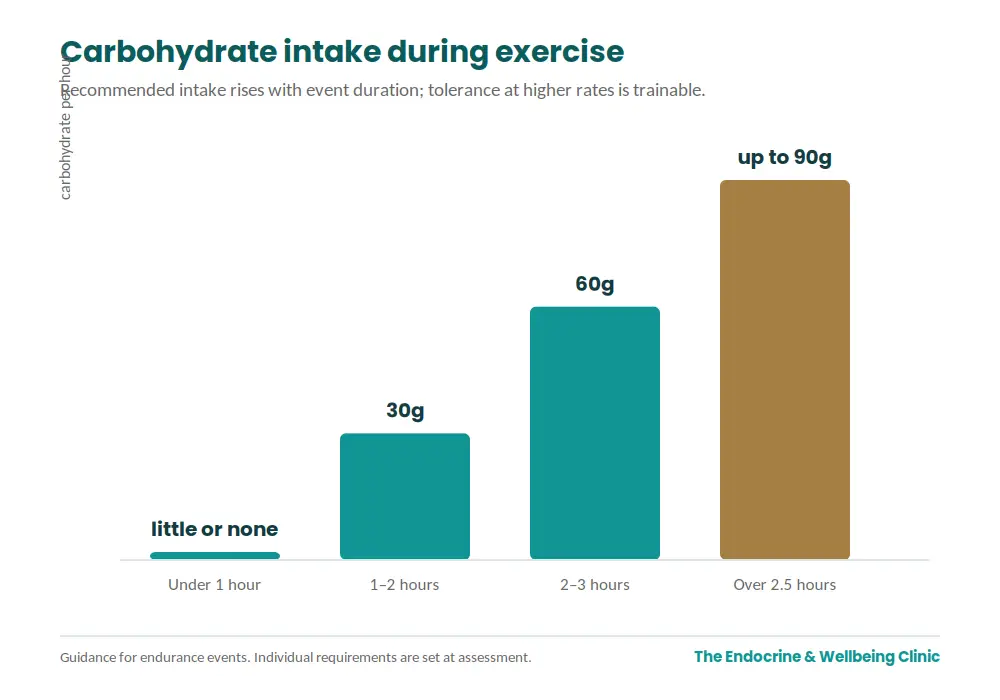
Competition and long-run fuelling, rehearsed in training. For events exceeding approximately two and a half hours, intakes approaching 90g of carbohydrate per hour are recommended, using glucose–fructose combinations that draw on separate intestinal transport pathways. Approximately half of trail runners consume less than the recommended amount during events of this duration. A fuelling protocol is developed and then progressively rehearsed in training, since tolerance to higher intake rates is trainable and is the principal determinant of gastrointestinal comfort in competition.
Energy availability and RED-S. Inadequate energy intake relative to training load results in Relative Energy Deficiency in Sport, with consequences for bone density, menstrual function, immune function and performance. Low carbohydrate availability appears to contribute independently of total energy intake. Where this is suspected, Dr Isobelle Smith can assess bone density and the relevant endocrine parameters, and Jessica Coombe (AEP) can address bone-loading exercise and training load.
Recovery and iron status. Following demanding sessions, carbohydrate intake of approximately 1.0–1.2g per kilogram per hour over the initial hours restores muscle glycogen, with protein provided to support adaptation. Iron status is also assessed, as iron deficiency is common in runners, particularly female runners, and is a correctable cause of unexplained fatigue and reduced performance.
Low-carbohydrate and fasted sessions have a legitimate role within a periodised program, and selected sessions are deliberately undertaken with reduced carbohydrate availability to promote specific adaptations. The difficulty arises when this pattern is applied continuously. Sustained low carbohydrate availability is associated with Relative Energy Deficiency in Sport and its effects on bone, endocrine function and performance. The relevant distinction is between deliberate periodisation and chronic under-fuelling, and it is the latter that presents most frequently.
This depends on duration and intensity. For events exceeding approximately two and a half hours, current guidance approaches 90g per hour using glucose–fructose combinations. Absorptive capacity at these rates is trainable, which is why intake is increased progressively during training rather than trialled in competition.
Most commonly because the gut has not been progressively adapted to absorb carbohydrate at competition intensity. This generally reflects insufficient rehearsal rather than an unsuitable product, and responds to a structured gut-training protocol.
It may. Recurrent bone stress injuries frequently indicate low energy availability — energy intake insufficient for the training being undertaken — which reduces bone density. Assessment of both dietary intake and bone health is warranted, and can be coordinated with Dr Smith.
Not in most cases, and pursuing weight loss can be counterproductive. Inadequate energy availability reduces bone density, disrupts menstrual function and impairs performance. The priority is adequate fuelling for the training being undertaken.
No referral is required to book. If you have a chronic condition, your general practitioner may be able to refer you under a chronic disease management plan for a Medicare rebate.
The Endocrine & Wellbeing Clinic
Phone: (02) 9870 3256
Locations: Balmain (inner west Sydney) and Telehealth Australia-wide
Affiliated with: Dietitians Australia, Sports Dietitians Australia, Endocrine Society of Australia
This page is not a substitute for individual medical advice. Book a consult for assessment specific to your situation.