Bone-loading exercise, prescribed to your DEXA results and fracture risk.
Jessica Coombe (AEP) prescribes bone-loading exercise as part of a treatment plan, working alongside your endocrinologist and GP. Programs are built around your bone density, your fracture history and your current medications — including Prolia (denosumab), bisphosphonates, romosozumab and teriparatide.
We commonly see patients with a diagnosis of osteopenia or osteoporosis on a DXA scan, or a history of low-trauma fracture, who have been told to keep active — and have been walking and doing pilates without knowing whether it is doing anything for their bones.
Others have recently started a bone-active medication, or are planning to come off one, and want the exercise side of their treatment structured to support it.
We also see post-menopausal bone loss, secondary causes of bone loss, and patients with a family history of osteoporosis who want to act early.
The common thread is uncertainty about what actually builds bone. Walking and pilates are good for cardiovascular health, balance and general strength — but the load they place on the skeleton sits below the threshold required to maintain or build bone density.
Bone is living tissue. It adapts to the mechanical load placed on it — and it deconditions when that load is absent. To maintain or build density, the load has to be heavy enough to trigger an osteogenic response, and progressive enough to keep the stimulus above the bone’s habitual level.
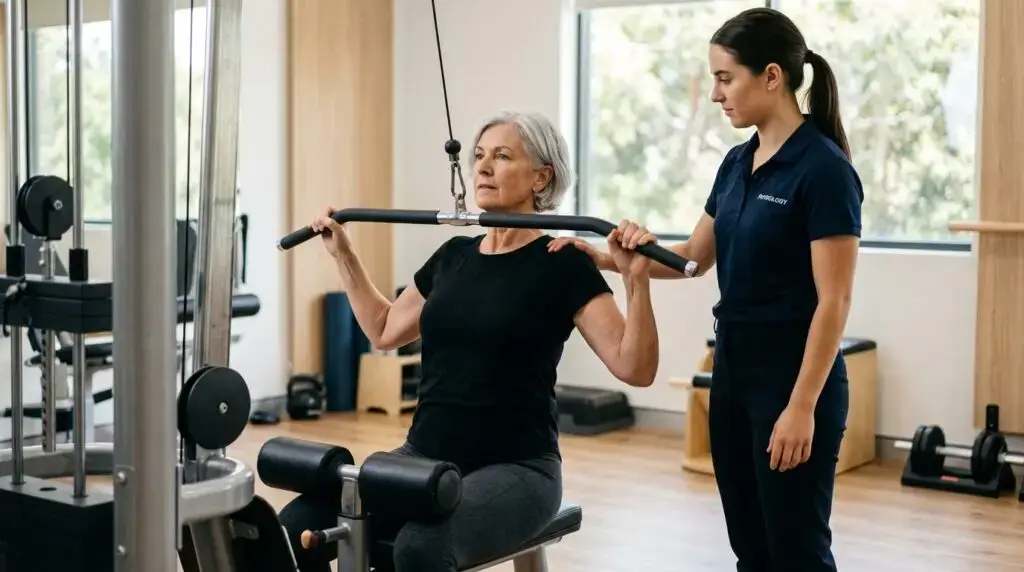
Bone-loading exercise. The stimulus that builds bone is high-intensity resistance and impact training — heavy, progressive loading of the spine and hip, performed with correct technique. Walking, swimming and cycling do not load bone enough to trigger new bone formation. Jessica Coombe (AEP) is ONERO Trained, and her small-group classes are bone-loading and osteoporosis-focused.
Loading matched to your bone density. High-intensity loading works only when it is matched to your bones. Loading is prescribed to your DEXA results and progressed as you adapt. High-risk patients — very low bone density, previous fracture, or significant kyphosis — are managed more conservatively, with impact loading introduced cautiously or omitted where it is not appropriate.

Strength, balance and falls prevention. Bone density is one factor in fracture risk; strength, balance and posture are the others. Most fragility fractures happen in a fall. Resistance training builds the muscle that supports weakened bone, and balance training reduces the chance of falling in the first place.
Coordination with your endocrinologist. If you are on a bone-active medication, the program is timed to support your medical treatment. This matters most around denosumab — bone density declines on cessation of Prolia, with rebound fracture risk in the first six to twelve months — so a transition off is planned, not improvised. Any decision to start, continue or stop a medication sits with your endocrinologist, such as Dr Isobelle Smith, with the exercise program built around it.
Every program is tailored to you — your goals, injury, symptoms and stage of recovery. What treatment looks like is decided at assessment, not before.
Your initial 60-minute assessment includes a detailed history, review of any relevant scans, discussion of your goals, and a movement assessment to identify the factors contributing to your condition. From there, a personalised exercise program is developed and taught with a strong focus on correct technique and long-term recovery.
Depending on your needs, treatment may include one-on-one sessions, small supervised group classes, a home exercise program, or a combination of these. Your program is reviewed and progressed regularly — based on your symptoms, movement quality, strength and functional goals — to return you safely to the activities that matter most.
Both are worth keeping. Walking supports cardiovascular health and daily activity; pilates builds control, posture and general strength — and both contribute to balance, which lowers fall risk. What neither provides is the loading stimulus that maintains or builds bone density. They belong alongside a bone-loading program, not in place of one.
Yes, when the loading is prescribed and supervised. The exercise is matched to your bone density and fracture risk, and progressed gradually. Avoiding heavy loading is the more dangerous option — bone needs the stimulus to maintain density.
No. Exercise and medication do different jobs. Medication reduces the rate of bone loss; exercise provides the mechanical stimulus the skeleton needs to respond to treatment, and supports the muscle and balance that reduce fall risk. The strongest results come from both.
Yes. The program is adjusted to your fracture history and current capacity. High-intensity loading is introduced cautiously, and the focus is on the loading your skeleton can tolerate safely. Many patients with previous fractures tolerate and benefit from progressive loading.
No. Exercise alongside Prolia supports the bone-density gains the medication is making. If you are planning to come off Prolia, exercise is particularly important — bone density declines on cessation of denosumab, and there is rebound fracture risk in the first six to twelve months. Any plan to reduce or stop is a decision for your endocrinologist to manage, with the exercise program built around it.
No referral is required to book. If you have a chronic condition such as osteoporosis, your general practitioner may be able to refer you under a chronic disease management plan for a Medicare rebate.
The Endocrine & Wellbeing Clinic
Phone: (02) 9870 3256
Locations: Balmain (inner west Sydney) and Telehealth Australia-wide
Affiliated with: ESSA (Exercise and Sports Science Australia), ANZBMS, Endocrine Society of Australia
This page is not a substitute for individual medical advice. Book a consult for assessment specific to your situation.