
Fuelling, recovery and body composition across a competitive season.
Isabelle (Bell) Smith is an Accredited Practising and Sports Dietitian working in professional sport, including with the Sydney Roosters, and lectures at the University of Newcastle.
We commonly see athletes whose performance declines in the second half of matches, or who train well during the week and underperform in competition. Total dietary intake is frequently adequate, but its distribution across the training and competition week is not matched to demand.
We also see athletes struggling to recover between fixtures during congested periods of the season, reporting persistent muscle soreness, disturbed sleep and reduced training quality.
Others present with body composition goals — increasing lean mass, or reducing body fat without compromising strength — and are pursuing them with approaches that impair training quality and performance.
We also see junior and developing athletes whose training load and growth have increased without a corresponding adjustment to dietary intake.

Team sports are intermittent and repeated, with demands that vary substantially between training sessions, matches and travel. Nutritional requirements therefore differ from those of endurance sport, and the practical task is matching intake to a variable weekly schedule and sustaining that across a season.
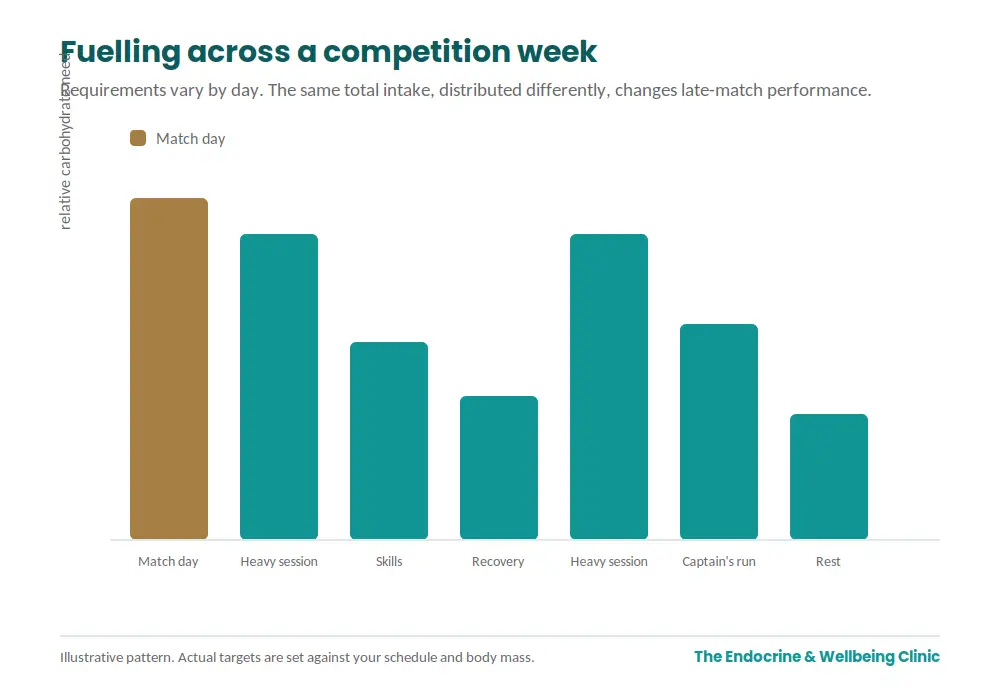
Fuelling the training week. Carbohydrate requirements differ considerably between a high-load session, a skills session and a match. Intake is periodised across the week so that high-demand days are adequately fuelled and lower-demand days adjusted, which frequently improves late-match performance without any change in total intake.
Protein for recovery and lean mass. Athletes require protein intakes above general population recommendations, distributed across the day rather than concentrated in a single meal. This supports tissue repair between fixtures, supports lean mass accrual where that is the objective, and preserves muscle where reduction in body fat is the objective.
Recovery between fixtures. Where the turnaround between matches is short, the priorities are glycogen restoration, protein for repair, replacement of fluid and electrolytes, and sleep. A specific post-match protocol is developed rather than leaving recovery nutrition to what happens to be available.
Body composition and performance. Altering body composition during a competitive season carries a risk of compromising performance. Where it is appropriate, it is undertaken with an energy deficit small enough to preserve training quality, protein intake sufficient to preserve lean mass, and timing that maintains fuelling for key sessions. Where an athlete’s history suggests low energy availability or disordered eating, this is screened for and addressed before any body composition work is undertaken.
The majority of performance concerns presenting to a sports dietitian relate to fuelling and recovery rather than supplementation, and supplements are generally the final element of a plan to be addressed rather than the first. Some have a sound evidence base and a defined role; many do not. Contamination also presents a genuine risk for athletes subject to anti-doping regulations, and any supplement should be verified against a recognised batch-testing programme before use. We will advise which are worth considering for your sport and which are not supported.
More than general population recommendations, distributed across the day rather than concentrated in one meal. The specific target depends on body mass, sport and whether the objective is lean mass accrual or maintenance, and is determined at assessment.
This depends on start time, travel and individual tolerance. The pre-match meal should be adequately fuelled and familiar, with continued intake before and during competition where the format permits. This is written as a specific protocol and rehearsed in training.
In some circumstances, provided it is undertaken carefully. An excessive energy deficit compromises training quality, strength and recovery. A modest change during the season, with more substantial change in the off-season, is generally more appropriate.
Yes. Growing athletes undertaking substantial training loads have higher requirements than adults of comparable body mass, and inadequate intake at this stage affects growth, bone development and injury risk.
No referral is required to book. If you have a chronic condition, your general practitioner may be able to refer you under a chronic disease management plan for a Medicare rebate.
The Endocrine & Wellbeing Clinic
Phone: (02) 9870 3256
Locations: Balmain (inner west Sydney) and Telehealth Australia-wide
Affiliated with: Dietitians Australia, Sports Dietitians Australia, Endocrine Society of Australia
This page is not a substitute for individual medical advice. Book a consult for assessment specific to your situation.