Dietitian for Eating Disorders
Nutritional rehabilitation for anorexia nervosa, bulimia nervosa, ARFID and OSFED, coordinated with specialist endocrine care.
Isabelle (Belle) Smith is an Accredited Practising Dietitian and eating disorder dietitian in Balmain who provides medical nutrition therapy for restrictive and purging eating disorders as part of a multidisciplinary team, alongside the clinic’s endocrinologists and the patient’s GP and psychologist.
What we commonly see in patients
We commonly see young women and men with anorexia nervosa who have been discharged from a hospital or day programme and need structured outpatient nutrition support to continue weight restoration. Many have a meal plan they no longer follow, a family who are unsure how to help, and a GP managing the medical monitoring alone.
We see adults with bulimia nervosa who have been unwell for years without disclosing it. The pattern is usually restriction through the day, loss of control in the evening, and purging or excessive exercise to compensate. Weight is often in the normal range, which is why the condition has gone unrecognised.
We see patients with avoidant/restrictive food intake disorder (ARFID), where a very limited range of accepted foods, fear of choking or vomiting, or low interest in eating has produced weight loss or nutritional deficiency without the body-image concerns of anorexia nervosa.
We also see athletes and dancers referred from our own athlete health service with relative energy deficiency in sport (RED-S), where under-fuelling has progressed into a diagnosable eating disorder with loss of menstrual function and bone stress injury.
The common thread is that nutrition has become the site of the illness. Approximately one million Australians are living with an eating disorder in any given year, and most are not receiving treatment (Deloitte Access Economics, 2012).
How we treat the condition
Eating disorders are not treated by a dietitian alone. The Australia and New Zealand Academy for Eating Disorders is explicit that dietetic intervention should be part of a multidisciplinary team and not delivered in isolation (Heruc et al., 2020). Our role is the nutritional rehabilitation arm of that team, with medical oversight available in the same clinic.
1. Nutritional assessment and a structured eating plan. The first task is a dietetic assessment that goes beyond a diet history: dietary rules, avoided foods, weight history, compensatory behaviours and the physical signs of starvation. From that, a written eating plan is built around regular eating — three meals and two to three snacks with no more than three to four hours between them — which is the foundation of enhanced cognitive behaviour therapy (CBT-E) for bulimia nervosa (Fairburn, 2008). The plan deliberately minimises exclusion of any food, including foods the patient considers unhealthy, because rigid food rules maintain the illness.
2. Safe weight restoration in anorexia nervosa. Weight restoration is the treatment that most reliably reverses the medical complications of anorexia nervosa. In the first one to two weeks of increased intake, the risk is refeeding syndrome — a shift of phosphate, potassium and magnesium into cells that can cause cardiac and neurological complications (Mehler et al., 2010). Belle sets the rate of increase in intake, and the clinic’s endocrinologists arrange the electrolyte monitoring in the early phase for patients at higher risk, so that outpatient refeeding is done with the same safeguards as an inpatient unit.
3. Breaking the restrict–binge–purge cycle in bulimia nervosa. Purging removes far less energy than patients believe, and the restriction that follows drives the next binge. Treatment establishes regular eating first, then addresses the dietary rules one at a time, with a food and symptom record used at each session. Belle works to the patient’s psychologist’s CBT-E formulation rather than running a separate programme, so that the patient receives one consistent message.
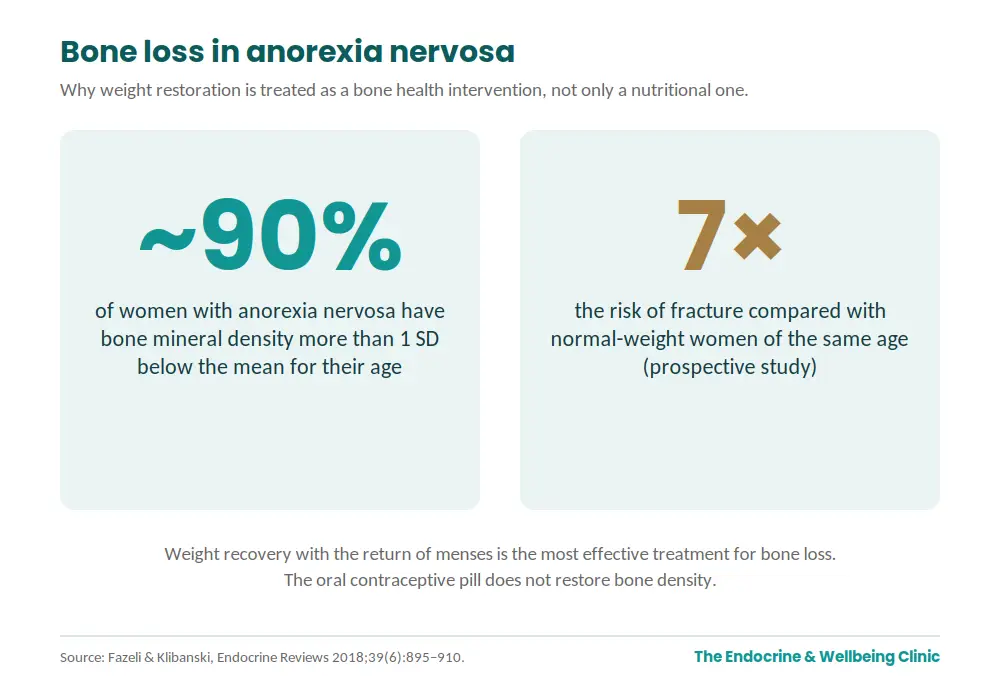
4. Endocrine and bone health management in the same clinic. Almost 90% of women with anorexia nervosa have bone mineral density more than one standard deviation below the mean for their age, and the risk of fracture is around sevenfold that of normal-weight women (Fazeli and Klibanski, 2018). Weight recovery with the return of menses is the most effective treatment for bone loss; the oral contraceptive pill does not restore bone density, and transdermal oestrogen shows only modest benefit. Dr Isobelle Smith, who trained in bone and calcium disorders at St Vincent’s Hospital and the Garvan Institute, assesses bone density, amenorrhoea and thyroid function in the same building, so that these complications are treated rather than noted.
What happens at your first appointment
- 15-minute discovery call — free. Belle establishes the diagnosis or presentation, who else is involved in treatment, and whether the clinic is the right setting or a higher level of care is needed.
- One-hour assessment. A full dietetic and eating disorder assessment: weight history, current intake, dietary rules and avoided foods, compensatory behaviours, menstrual function, physical symptoms and blood test results. For anorexia nervosa, refeeding risk is assessed and medical review arranged.
- Your plan. A written eating plan with a regular eating structure, a rate of change agreed with you, and a clear plan for what is monitored and by whom.
- Review. Fortnightly or weekly review depending on medical risk, with written reports to your GP after the first session and at the end of each course of treatment, and communication with your psychologist throughout.
A note about being told to just eat more
The advice is not wrong; eating more is the treatment. The difficulty is that an eating disorder is defined by the inability to do so, and instructions to eat more without a structure, a rate of change, and someone to manage the fear that accompanies each increase tend to fail and to confirm the patient’s belief that they cannot recover. Structured nutritional rehabilitation exists because the instruction is correct and, on its own, insufficient.
For GPs
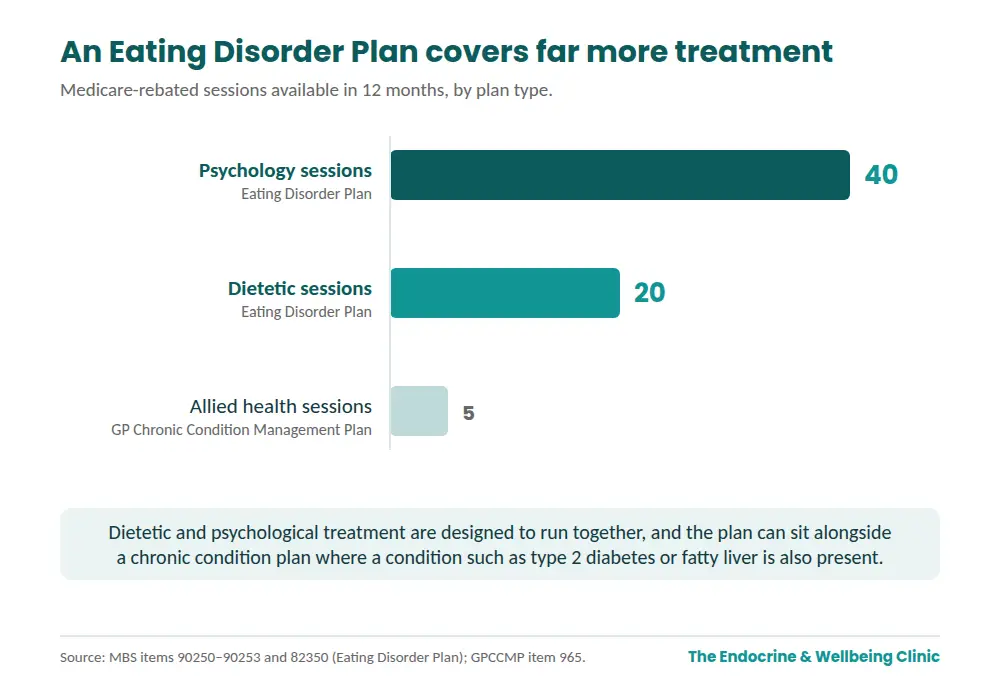
Patients who meet the criteria for an Eating Disorder Treatment and Management Plan can access up to 20 dietetic sessions (MBS item 82350) and up to 40 psychological sessions in a 12-month period. Eligibility is a clinical diagnosis of anorexia nervosa, or bulimia nervosa or OSFED with an EDE-Q score of 3 or more, rapid weight loss or binge eating or compensatory behaviour at least three times per week, and two or more of: clinically underweight, current or high risk of medical complications, a serious comorbid medical or psychological condition, a hospital admission for the eating disorder in the past 12 months, or an inadequate response to treatment over the past six months. The plan is prepared under MBS items 90250 to 90253 and reviewed under items 90264 and 90265, and can be used alongside a GP Chronic Condition Management Plan where the patient also has a chronic condition. Refer via HealthLink (EDI endwelcl), fax 02 7241 7040 or admin@endocrinewell.com.au. Belle is happy to take a call about any patient before a plan is written.
Frequently asked questions
No. Bulimia nervosa and most cases of OSFED occur at a normal or higher weight. Weight is one measure of medical risk, not a criterion for whether the illness is real or whether treatment is warranted.
Only where weight restoration is medically necessary, as in anorexia nervosa, and then at a rate agreed with you and your treating team. For bulimia nervosa and ARFID at a stable weight, the aim is a regular and adequate eating pattern, not weight change.
Yes. An Eating Disorder Plan is designed around dietetic and psychological treatment running together, and the dietitian, endocrinologists and exercise physiologist are all here under one roof. If you already have a psychologist, Belle coordinates with them so you receive one consistent plan. If you don’t, we can suggest experienced eating disorder psychologists we work with in your local area, and your GP can refer you under the same plan.
For adolescents and young adults, family involvement is central to treatment, and parents are welcome at sessions. For adults, involvement is your choice, and a support person is often helpful at the planning stage.
No referral is required to book. If you meet the criteria for an Eating Disorder Plan, your general practitioner can refer you for up to 20 Medicare-rebated dietetic sessions in 12 months. Where you also have a chronic condition, a chronic condition management plan may apply as well.
Book a discovery call
The Endocrine & Wellbeing Clinic
Phone: (02) 9870 3256
Locations: Balmain (inner west Sydney) and Telehealth Australia-wide
Affiliated with: Dietitians Australia, Sports Dietitians Australia, Endocrine Society of Australia
This page is not a substitute for individual medical advice. Book a consult for assessment specific to your situation.