
Cardiometabolic and preventative cardiology
Cardiovascular risk assessment and prevention for people with diabetes, obesity, high blood pressure or high cholesterol.
Dr Farrah Othman (FRACP), cardiologist, provides preventative cardiology in Balmain within The Endocrine & Wellbeing Clinic, where the diabetes, weight and lipid conditions that drive cardiovascular risk are treated by endocrinologists in the same rooms.
What we commonly see in patients
We commonly see people with type 2 diabetes, or on a GLP-1 medication for weight, who have never had a cardiac assessment and want to know their actual risk of a heart attack rather than a general warning.
We see people in their 40s and 50s with a parent who had a heart attack young, a borderline cholesterol, and a GP who has reasonably said the decision about a statin could go either way.
We see people with high blood pressure on three tablets that is still not controlled, or who have been told their blood pressure is “fine” when it is not at the target that applies to someone with diabetes or kidney disease.
The common thread is risk that has not yet become disease, and a decision about treatment that a risk score alone cannot settle. The diagnoses are type 2 diabetes, obesity and metabolic syndrome, hypertension and dyslipidaemia.

How we treat the condition
People with type 2 diabetes have about twice the risk of coronary heart disease of people without it. Obesity, high blood pressure and high cholesterol each add to that risk, and they cluster. Preventative cardiology quantifies the risk, refines it where a score is uncertain, and treats it before an event rather than after. Most of the treatment is medical and lives in the endocrine clinic; the cardiologist’s role is the assessment and the cardiac tests.
1. Risk assessment that goes beyond the calculator. The 2023 Australian cardiovascular risk guideline assesses five-year risk in adults aged 45 to 79, from 35 in people with diabetes and from 30 for Aboriginal and Torres Strait Islander people, and classifies it as low (under 5%), intermediate (5 to under 10%) or high (10% and above). Where the result sits near a treatment threshold, a coronary artery calcium (CAC) score reclassifies it: a score of zero moves risk down, a score of 100 or more, or above the 75th percentile for age and sex, moves it up. The Cardiac Society of Australia and New Zealand regards a score of 400 or more as high risk warranting high-intensity statin therapy. A family history of premature coronary disease and chronic kidney disease also move risk up. Lipoprotein(a) and ApoB are measured where the family history or the lipid pattern warrants it.
2. Blood pressure, treated to target. Each 10 mmHg reduction in systolic blood pressure reduces major cardiovascular events by about 20% (Ettehad et al., 2016). In the SPRINT trial, treating to a systolic target below 120 mmHg rather than below 140 mmHg reduced major cardiovascular events by 25% in people at high risk without diabetes, at the cost of more low blood pressure and kidney effects. Australian guidance sets a target below 140/90 mmHg for most people, lower where tolerated, and Dr Othman’s usual target is below 125/80 mmHg, or 135/85 mmHg in older people at risk of falls. Ambulatory 24-hour monitoring establishes the true level before medication is changed.
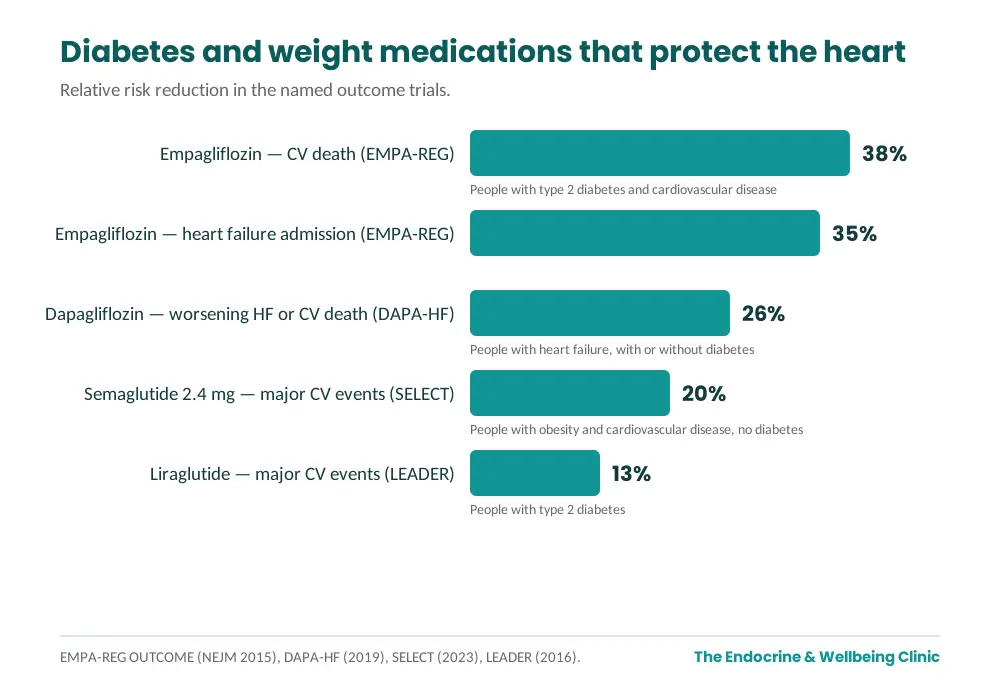
3. Diabetes and weight medications that protect the heart. Several diabetes and obesity medications reduce cardiovascular events independently of their effect on glucose or weight. Empagliflozin (Jardiance), an SGLT2 inhibitor, reduced cardiovascular death by 38% and heart failure hospitalisation by 35% in people with type 2 diabetes and established cardiovascular disease (EMPA-REG OUTCOME); dapagliflozin (Forxiga) reduced worsening heart failure or cardiovascular death by 26% in people with heart failure, with or without diabetes (DAPA-HF). Among GLP-1 receptor agonists, liraglutide (Victoza) reduced major cardiovascular events by 13% (LEADER) and semaglutide 2.4 mg (Wegovy) by 20% in people with obesity and established cardiovascular disease who did not have diabetes (SELECT). Choosing and prescribing these is Dr Isobelle Smith’s work; Dr Othman’s assessment identifies who stands to gain.
4. Lipids, diet and exercise, in one building. Where LDL cholesterol stays above target on a maximal statin, ezetimibe is added and then a PCSK9 inhibitor (evolocumab, Repatha; alirocumab, Praluent) or inclisiran (Leqvio), which are PBS-subsidised for established cardiovascular disease or familial hypercholesterolaemia with LDL above 1.8 mmol/L despite treatment. A Mediterranean dietary pattern reduced major cardiovascular events by about 30% in PREDIMED; the clinic’s dietitian, Isabelle Smith (APD), delivers it as a programme rather than a leaflet. After a cardiac event, exercise-based cardiac rehabilitation reduces recurrent heart attack by 28% and hospital admission by 42%, and Jessica Coombe (AEP) supervises it.
What happens at your first appointment
- Consultation and examination. Dr Othman takes your history, family history and medication history, measures blood pressure and waist circumference, and reviews your blood tests. Around 20 minutes.
- Investigations in-rooms. An ECG and, where indicated, an echocardiogram or stress echocardiogram, taking a further 20 to 30 minutes.
- Your plan. Your five-year risk, whether a calcium score or further blood tests would change the decision, the blood pressure and LDL targets that apply to you, and the treatment matched to them, in writing and coordinated with the endocrinologist managing your diabetes or weight.
- Letter to your GP. A letter is sent to your GP or referrer within the week.
A note about fish oil and supplements
Many patients arrive taking fish oil, red yeast rice or plant sterol capsules in place of a statin. In the SPORT trial (2023), low-dose rosuvastatin lowered LDL cholesterol by 37.9% over 28 days, while fish oil, cinnamon, garlic, turmeric, plant sterols and red yeast rice were no different from placebo. Over-the-counter fish oil has no benefit for LDL cholesterol or any cardiovascular outcome. Red yeast rice contains a naturally occurring statin in an unregulated dose and some products have been contaminated with citrinin, a kidney toxin. Plant sterols do lower LDL by 0.3 to 0.4 mmol/L at 2 to 3 g a day, but only as fortified foods, not as capsules. None of this is a reason to stop a supplement you find useful for another purpose; it is a reason not to rely on one for your heart.
Frequently asked questions
Not automatically. Diabetes roughly doubles cardiovascular risk but under the 2023 Australian guideline it is assessed with the risk calculator rather than treated as high risk by default. A calcium score or a family history can settle a borderline decision.
A short CT scan without contrast that measures calcified plaque in the coronary arteries. It is useful in people without symptoms whose risk sits near a treatment threshold, where a score of zero can avoid medication and a high score can justify it. It is not rebated by Medicare and is not used in people with symptoms or known coronary disease.
Semaglutide 2.4 mg reduced major cardiovascular events by 20% in people with obesity and existing cardiovascular disease. Whether that applies to you depends on your risk and your other conditions, which is what the assessment establishes.
Sometimes. Weight loss, salt reduction and exercise lower blood pressure, and medication is reviewed as they take effect. Ambulatory monitoring confirms the change before anything is stopped.
A referral from your GP or another specialist is required for a Medicare rebate on a specialist cardiology consultation. Ask reception if you are unsure whether yours is current.
Book an appointment
The Endocrine & Wellbeing Clinic
Phone: (02) 9870 3256
Locations: Balmain (inner west Sydney) and Telehealth Australia-wide
Affiliated with: Cardiac Society of Australia and New Zealand, Australian Atherosclerosis Society, European Society of Cardiology, Australian Diabetes Society
This page is not a substitute for individual medical advice. Book a consult for assessment specific to your situation.