Cholesterol and statins
High cholesterol, statin treatment, lipoprotein(a) and familial hypercholesterolaemia, assessed and treated by a cardiologist.
Dr Farrah Othman (FRACP), cardiologist, provides cholesterol and statin treatment in Balmain within The Endocrine & Wellbeing Clinic, alongside the clinic’s endocrinologists and dietitian.
What we commonly see in patients
We commonly see people whose GP has found a high LDL cholesterol on a routine blood test and recommended a statin, and who want a second view before starting a tablet for life. Some have read that statins cause muscle pain or memory loss; some have tried a statin, had aches, and stopped.
We see people already on a statin whose LDL is still above target, or who have been told their cholesterol is a bit high when in fact it sits in a range that suggests an inherited cause.
We see people with a parent or sibling who had a heart attack young, who want to know whether the same thing is coming for them and what, if anything, a blood test can tell them.
The common thread is a single number on a blood test and a decision that lasts decades. The diagnoses are hypercholesterolaemia, elevated lipoprotein(a) and familial hypercholesterolaemia.
How we treat the condition
While cholesterol metabolism is determined by many things, especially genetics, whole foods high in fibre and plant sterols have been shown to reduce cholesterol to some extent. Statins are medications that lower cholesterol in the blood, particularly “bad” cholesterol (LDL-C). They work by blocking an enzyme in the liver that produces cholesterol. Which is appropriate depends on your overall cardiovascular risk, not on the cholesterol number alone.
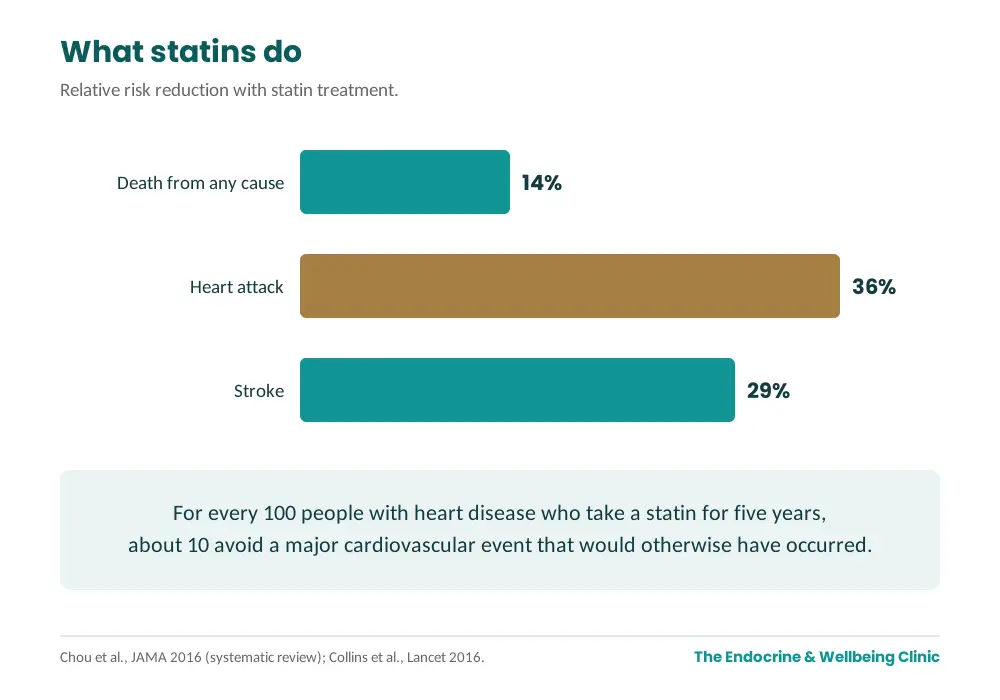
1. Why statins are prescribed, and how effective they are. If you’ve had a heart attack, stroke, or other cardiovascular event, you’re at higher risk of having another one. Statins reduce the risk of this significantly by reducing circulating LDL, stabilising plaque in arteries and reducing inflammation in blood vessels. Even if you have not had a heart attack or stroke, if you have coronary artery disease, statins significantly reduce the chance of this and over time can reduce the plaque. The most important mechanism is plaque stabilisation, preventing progression of the plaque, and the absence of heart attacks. If you do not have coronary artery disease, but you have high cholesterol and other risk factors such as a family history, diabetes, high blood pressure, or you smoke, then they can reduce your chances of developing significant plaque or heart attacks. In patients with coronary artery disease, they reduce the risk of death from any cause by around 14%, heart attacks by 36%, strokes by 29%, and the need for stents or cardiac surgery. For every 100 people with heart disease who take statins for 5 years, about 10 will avoid a major cardiovascular event that would have otherwise occurred.
2. Side effects. Muscle aches: a large-scale, good-quality study demonstrated that most muscle symptoms that occur in patients taking statins are just as likely with placebo pills. Often there is another cause for the muscle pains, and other factors may be contributing. It is important to discuss side effects with your doctor; there is often a solution which may include changing the statin to a different type or changing the dosing schedule. Sometimes replacing vitamin D (if it is low), and treating competing issues like thyroid disease, can help improve these symptoms. Increased blood sugar or new diabetes (5 to 10 people per 1,000 treated), however this has not been shown to be associated with adverse cardiac outcomes. Rare: serious muscle damage (about 1 person per 2,000 treated for 5 years), which can be diagnosed by testing the creatine kinase levels.
3. Foods with good evidence for lowering cholesterol, and supplements. Plant sterols/stanols, sometimes added to margarine, yoghurt or other fortified foods, reduce LDL-C by blocking cholesterol absorption in the intestine; typically doses of 2 to 3 g/day are needed to reduce LDL-C by ~0.3 to 0.4 mmol/L. Soluble fibre, when combined with liquid, helps remove bile acids so that the liver uses more LDL-C to make new bile acids: oats and barley (3 daily servings of oats lowers LDL-C <0.13 mmol/L), psyllium husk (the most evidence behind it; at least 10 g per day to reduce LDL-C), legumes (soluble fibre and plant protein). Nuts: one serving per day reduces LDL-C by 0.12 mmol/L. Polyunsaturated fats (fish, nuts, flax, chia seeds) and monounsaturated fats (olive oil, avocados, canola oil), the "good" fats. Soy protein, especially in place of animal protein. Vegan diets. Foods to avoid: saturated fats such as red meat, butter, high-fat dairy and coconut oil, which raise LDL-C. Supplements: red yeast rice extract contains naturally occurring statins (monacolins), particularly monacolin K, which is chemically the same as lovastatin, and there is evidence it can reduce LDL-C. The 2024 SPORT trial challenged this when it compared supplements like red yeast rice extract to low-dose rosuvastatin: rosuvastatin reduced LDL-C by 37.9% and the supplements showed no reduction in LDL-C compared to placebo. There are safety concerns as it is unregulated, and a contamination risk: some products have been found contaminated with citrinin (a nephrotoxic mycotoxin). Berberine shows modest LDL-C reduction in combination with other compounds. Fish oil (over the counter): no benefit for LDL-C or any outcomes. Plant sterols as a supplement: no benefit, though food-fortified sources have better evidence.
4. Lipoprotein(a) and familial hypercholesterolaemia. Lipoprotein(a) [Lp(a)] is a blood test which is not currently covered by Medicare and generally costs around $50 to $90 in Australia. Typically we only need to test it once in a person’s life; however, as treatments targeting Lp(a) emerge, we may start testing it more frequently. It may also be useful to test again after a woman has completed menopause. Lp(a) is like LDL cholesterol with an additional protein attached. Levels are mostly genetically determined (diet and exercise have little influence). People with elevated Lp(a) are 2 to 4 times more likely to develop coronary artery disease, calcific aortic stenosis (a type of valve disease), and cerebral (strokes) and vascular disease. It causes inflammation, increased risk of clots and coronary artery disease. International guidelines recommend measuring Lp(a) at least once in a lifetime for adults, especially for those with a family history of premature ASCVD; familial hypercholesterolaemia; onset of coronary artery disease without typical risk factors; family members with high Lp(a); calcific aortic valve stenosis; or persistently high LDL despite good medical treatment. Treatment targeting Lp(a) is still being investigated in large-scale trials. PCSK9 inhibitors have been found to reduce levels of Lp(a); however, this has not been studied independently and is not approved in Australia for the treatment of Lp(a) alone. People with elevated Lp(a) should be treated as high risk for heart disease, receive intensive management of other risk factors and be monitored closely. Familial hypercholesterolaemia (FH) is a genetic condition which results in a mutation in the LDL receptor, meaning LDL cannot enter the cells and builds up in the bloodstream, eventually depositing in the artery walls. It causes early-onset heart disease. It is one of the most common inherited conditions and 1 in 300 people in Australia have it. It is more common in some ethnic groups, such as Afrikaner, Christian Lebanese, Ashkenazi and French-Canadians. Dr Isobelle Smith (FRACP) manages complex and inherited lipid disorders in the same clinic.
What happens at your first appointment
- Consultation and examination. Dr Othman will see you first and examine you for around 20 minutes.
- Investigations in-rooms. You will then have investigations, such as an ECG, echocardiogram, or stress echocardiogram, which will take 20 to 30 minutes.
- Your plan. She will then speak to you again and arrange any further investigations, management and follow-up.
- Letter to your GP. A letter will be written and sent to your GP or referrer within the week.
A note about statins and memory
Large, high-quality studies show that statins do not cause dementia or Alzheimer’s disease. In fact, the evidence suggests statins may reduce your risk of developing dementia. Multiple large trials involving 1.4 million people have examined this and found no difference in memory between people taking statins and those taking placebo pills. Several studies have shown that statins reduce the risk of dementia. In 2024 an analysis demonstrated that statins reduce dementia risk by 20 to 30%, likely by preventing strokes, improving blood flow to the brain, and reducing inflammation in blood vessels. If you have noticed a change in your memory since starting statins, the symptoms should typically be mild and resolve within a few weeks.
Frequently asked questions
If you have coronary disease, yes, unless a side effect cannot be managed. If you are taking it for prevention without established disease, the decision is reviewed as your risk changes.
While cholesterol metabolism is determined by many things, especially genetics, whole foods high in fibre and plant sterols have been shown to reduce cholesterol to some extent. Whether that is sufficient depends on your starting level and your overall risk.
If you have very high cholesterol (LDL) and a family member has had early-onset heart disease (younger than 55 in men and 60 in women), speak to your cardiologist about genetic testing. Specialists can order the genetic test, and you may be eligible for a Medicare rebate. If someone in your family has had a positive genetic test for FH, then your GP may be able to request it, and you will still be eligible for the rebate. Useful websites: the FH Australasia Network (athero.org.au/fh) and Sonic Genetics FH patient information (sonicgenetics.com.au).
Fish oil (over the counter): no benefit for LDL-C or any outcomes.
A referral from your GP or another specialist is required for a Medicare rebate on a specialist cardiology consultation. Ask reception if you are unsure whether yours is current.
Book an appointment
The Endocrine & Wellbeing Clinic
Phone: (02) 9870 3256
Locations: Balmain (inner west Sydney) and Telehealth Australia-wide
Affiliated with: Cardiac Society of Australia and New Zealand, Australian Atherosclerosis Society, European Society of Cardiology
This page is not a substitute for individual medical advice. Book a consult for assessment specific to your situation.