
Heart investigations
Echocardiogram, stress echocardiogram, ECG, Holter monitor, ambulatory blood pressure and cardiac CT: what each test does and how to prepare.
Heart investigations in Balmain are performed in-rooms at The Endocrine & Wellbeing Clinic by an experienced cardiac sonographer and reported by Dr Farrah Othman (FRACP), cardiologist, who also reports cardiac CT for Spectrum Radiology and holds accreditation in CT coronary angiography. In-rooms echocardiography and stress testing commence on 24 November 2026. GPs and specialists can refer directly for tests without a cardiology consultation.
What we commonly see in patients
We commonly see people referred for a specific test, an echocardiogram for a murmur, a Holter for palpitations, a stress test for chest pain, who want to know what the test will show, how long it takes and whether it hurts.
We see people who have had a normal resting ECG and been reassured, but whose symptoms occur only on exertion, where a resting trace cannot be expected to show anything.
We see people with high blood pressure readings in the surgery and normal readings at home, or the reverse, where a single clinic measurement cannot settle whether treatment is needed.
The common thread is that the right test depends on the question: structure and pumping function, blood supply under load, rhythm over time, or blood pressure over a day.

How we treat the condition
Most cardiac questions can be answered without a catheter. The tests below are non-invasive, performed in the clinic rooms or at a radiology practice, and ordered in sequence rather than all at once. Dr Othman performs the examination first and chooses the investigation that answers the question raised.
1. Echocardiogram and stress echocardiogram. A transthoracic echocardiogram is an ultrasound of the heart through the chest wall, with no radiation, showing chamber size, pumping function (ejection fraction), wall thickness, valve disease and pressures in the heart and lungs. A stress echocardiogram adds a treadmill: resting images are taken, you walk on a treadmill that becomes faster and steeper every three minutes for as long as you can, and images are repeated immediately afterwards to look for an area of heart muscle whose blood supply falls short under load. The appointment takes about 45 minutes. Wear a two-piece outfit and comfortable walking shoes, avoid talc or body lotion on the chest, and tell the clinic if you have diabetes or use an inhaler; some medications may need to be withheld beforehand and you will be told at booking.
2. ECG and Holter monitor. A 12-lead ECG takes a few minutes and records the heart’s rhythm and electrical pattern at rest; it can show a heart attack in progress, prior damage, rhythm disturbance or strain. Because it captures only seconds, symptoms that come and go need a Holter monitor: a small recorder worn continuously for 24 hours, or for up to seven days for infrequent palpitations, dizziness or unexplained fainting. You go about your normal day and keep a diary of symptoms so they can be matched to the trace.
3. Ambulatory blood pressure monitoring. A cuff worn for 24 hours that inflates automatically through the day and night. It separates true hypertension from white-coat readings, detects blood pressure that fails to fall overnight, and is the test used for people whose clinic readings sit between 140/90 and 180/110 mmHg before any blood pressure medication is started. Dr Othman reports the recording with a treatment plan.
4. Cardiac CT: coronary angiography and calcium score. CT coronary angiography (CTCA) uses contrast dye to show the coronary arteries, the type of plaque and the degree of narrowing without a catheter. It is highly sensitive and its chief strength is ruling coronary disease out: a normal CTCA makes significant disease very unlikely. It grades the severity of a narrowing with less accuracy than an invasive angiogram. In the SCOT-HEART trial (2018), CTCA-guided care in people with stable chest pain reduced death from coronary disease or non-fatal heart attack over five years from 3.9% to 2.3%. Medicare rebates CTCA when requested by a specialist for symptoms of coronary ischaemia at low-to-intermediate risk. Preparation: no caffeine or cigarettes for 12 hours, no food for 2 hours, a medication to slow the heart rate on the day, a cannula for contrast and a breath-hold of 10 to 15 seconds; the scan itself takes 10 to 15 minutes. A coronary artery calcium score is a shorter scan without contrast that measures calcified plaque; it is not Medicare-rebated and is used in people without symptoms when the result would change a decision about statin or blood pressure treatment. Both are performed at a radiology practice and reported by Dr Othman. Home sleep studies, worn overnight in your own bed with a small portable kit fitted at the clinic, can also be arranged for patients with suspected sleep apnoea, which is closely linked to blood pressure, rhythm disturbance and heart failure; the result is reviewed by your treating specialist, who will refer on if needed.
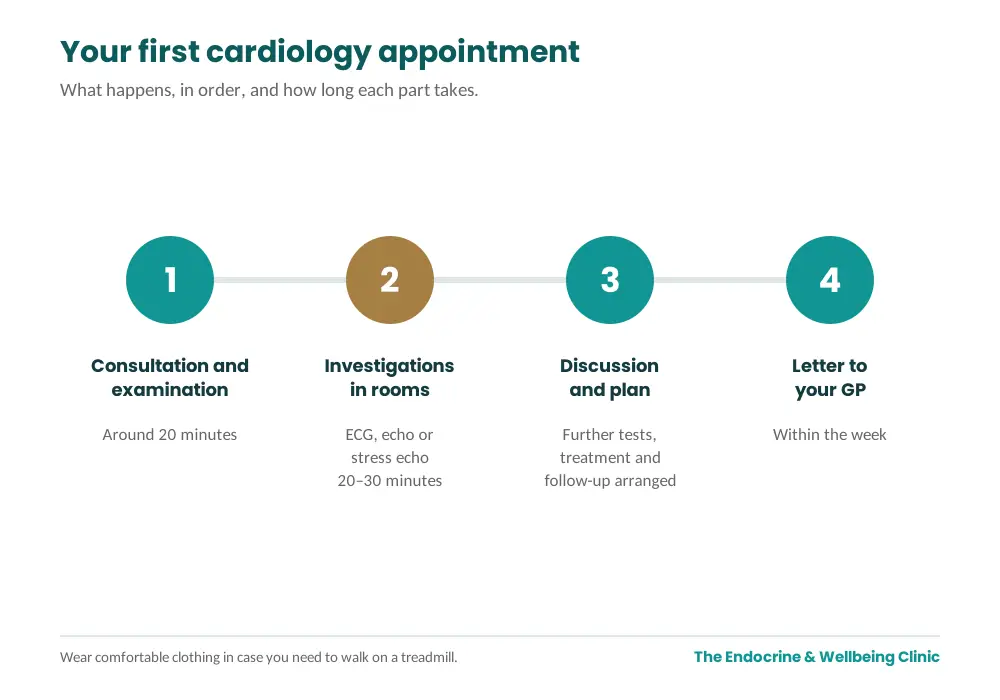
What happens at your first appointment
- Consultation and examination. Dr Othman takes your history and examines you. Around 20 minutes.
- Investigations in-rooms. An ECG and, where indicated, an echocardiogram or stress echocardiogram, taking a further 20 to 30 minutes. Wear comfortable clothing in case you need to walk on a treadmill.
- Your plan. Dr Othman reviews the results with you and arranges any further investigations, such as a Holter, ambulatory blood pressure monitor or cardiac CT.
- Letter to your GP. A letter is sent to your GP or referrer within the week.
A note about the test your GP already did
A normal resting ECG from your GP is a useful result, and it was the right first test. It rules out a heart attack in progress and some rhythm problems. It cannot show whether the heart’s blood supply is adequate under exertion, which is why chest pain on effort with a normal resting ECG is a reason for a stress test rather than reassurance. Equally, a single raised blood pressure reading is a reason to measure over 24 hours, not to start medication.
Frequently asked questions
No. It is an ultrasound: gel on the chest and a probe moved over it, lying on your left side. There is no radiation and no injection.
A two-piece outfit with a shirt that opens at the front, and walking shoes. No talc or body lotion on the chest. Bring your inhaler if you use one.
A small recording kit is fitted at the clinic and you sleep at home as normal, returning it the next day. It records breathing, oxygen levels and heart rate overnight. Your treating specialist reviews the result and refers you on if treatment is needed.
It involves a small dose of radiation, around 2 to 5 millisieverts, and iodinated contrast. Kidney function is checked beforehand in people over 70 or with diabetes or kidney disease, and metformin is withheld on the day and for 48 hours afterwards.
Yes. GPs and specialists can refer directly for an echocardiogram, stress echocardiogram, Holter or event monitor, 24-hour blood pressure monitor or home sleep study without a cardiology consultation. The test is reported by Dr Othman and the report is sent to the referring doctor. Referrers can download the diagnostics request form on this page.
A referral from your GP or another specialist is required for a Medicare rebate on a specialist cardiology consultation. Ask reception if you are unsure whether yours is current.
Book an appointment
The Endocrine & Wellbeing Clinic
Phone: (02) 9870 3256
Locations: Balmain (inner west Sydney) and Telehealth Australia-wide
Affiliated with: Cardiac Society of Australia and New Zealand, Australian Atherosclerosis Society, European Society of Cardiology
This page is not a substitute for individual medical advice. Book a consult for assessment specific to your situation.