
Coronary angiogram and stents
What happens during a coronary angiogram or percutaneous coronary intervention, and what to expect afterwards.
Dr Farrah Othman (FRACP) is an interventional cardiologist who performs coronary angiogram and stent procedures at St George Private Hospital, the Mater Hospital and North Shore Private Hospital, with consultation and follow-up at The Endocrine & Wellbeing Clinic in Balmain.
What we commonly see in patients
We commonly see people who have been told they need an angiogram and want to know what it involves: whether they will be awake, where the tube goes in, how long they will be on the table and when they can drive.
We see people who had a stent during an admission for a heart attack. The procedure was done urgently, the explanation was brief, and they have questions about what was found, what was done and why they are now on two blood thinners.
We see people with stable angina who have been offered a stent and are unsure whether to have one, having read that stents do not always help. That is a legitimate question with a clear evidence base, and it is addressed below.
The common thread is a procedure that is well understood by cardiologists and poorly explained to patients.

How we treat the condition
A coronary angiogram is an X-ray procedure that visualises the coronary arteries and is performed in a catheterisation laboratory in the hospital. Dr Othman has advanced training in complex coronary intervention, including diagnostic right and left heart catheterisation, balloon angioplasty, stent placement and physiology testing, radial and femoral artery access, ultra-low-contrast coronary angiography, coronary atherectomy and intravascular lithotripsy for severe coronary calcification, bifurcation stenting, and coronary imaging with intravascular ultrasound (IVUS) and optical coherence tomography (OCT).
1. The procedure. You will typically be awake, with a little bit of sedating medication. You will be comfortable, but you need to stay still on a bed for around 1 hour (usually less). A small box-shaped X-ray machine will move around you to take the pictures. Local anaesthetic is injected at the site of access, either in the wrist (radial artery) or groin (femoral artery). Most procedures today are done through the wrist, as the bleeding risk is much lower and recovery is quicker. There may still be some bruising, especially if you are prone to bruising. Sometimes we need to perform the procedure through the groin for various anatomical or procedural reasons.
2. Seeing the arteries. A thin, flexible tube (catheter) is placed into the artery and is advanced through the blood vessels to the heart. A special dye is injected through the catheter, making the coronary arteries visible on X-ray images. This allows us to see exactly where and how severely the arteries are narrowed.
3. Placing a stent. A stent is a small, expandable metal scaffold. During the procedure, a balloon catheter is advanced over a wire to the narrowed area. The balloon is inflated to compress the plaque against the artery wall, and the stent is expanded and left in place permanently. The stent acts as scaffolding to keep the artery open and maintain blood flow to the heart muscle. Modern drug-eluting stents are coated with medication that slowly releases over time to prevent the artery from narrowing again (restenosis). The antiplatelet medications are also important to prevent clots forming in the stent.
4. Medication afterwards, and the conditions underneath. After a heart attack or stent placement, dual antiplatelet therapy (aspirin plus another antiplatelet, such as clopidogrel) is typically used for a period. If you have CAD, and after a stent or a heart attack, you will remain on one antiplatelet for life provided there has been no major bleeding. If you require non-cardiac surgery or a dental procedure, please contact your cardiologist to discuss the best course of action before stopping any of these medications. The diabetes, cholesterol and weight management that determine whether another stent is ever needed are provided by Dr Isobelle Smith (FRACP) and the clinic’s dietitian and exercise physiologist in the same building.
What happens at your first appointment
- Consultation and examination. Dr Othman will see you first and examine you for around 20 minutes.
- Investigations in-rooms. You will then have investigations, such as an ECG, echocardiogram, or stress echocardiogram, which will take 20 to 30 minutes.
- Your plan. She will then speak to you again and arrange any further investigations, management and follow-up, including whether an angiogram is indicated, at which hospital, and the preparation needed.
- Letter to your GP. A letter will be written and sent to your GP or referrer within the week.
A note about having a stent for stable angina
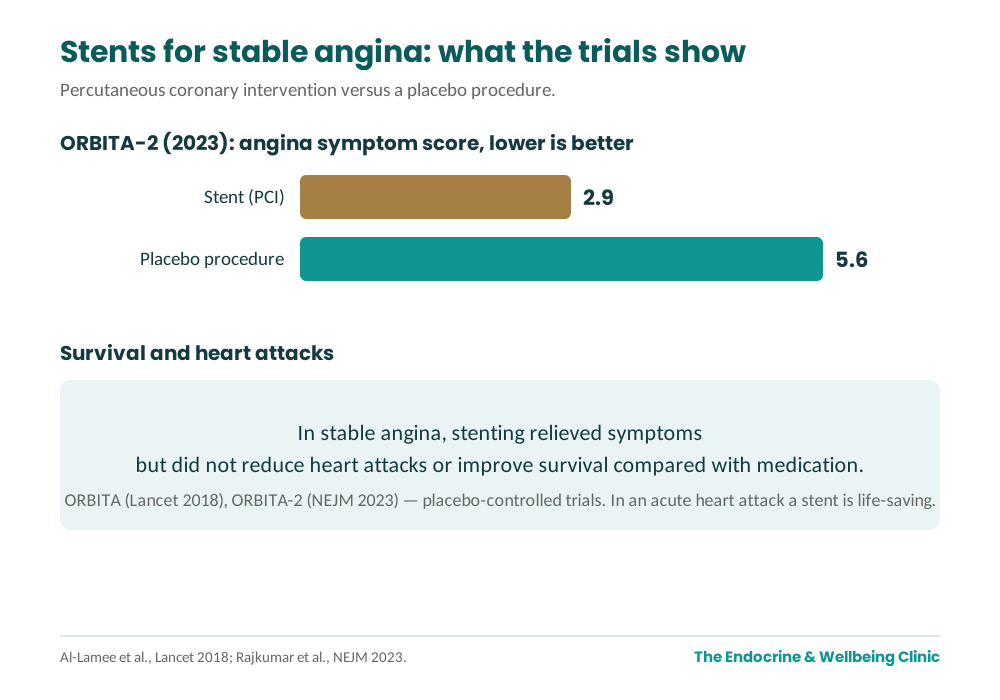
PCI plays different roles depending on the clinical situation. In an acute heart attack, a stent is a life-saving treatment. It opens the blocked artery and restores blood flow to the heart muscle. In stable angina, stents are reserved as a last resort for refractory symptoms that don’t respond to medication. Stents in this situation do not improve survival or reduce heart attacks when compared to medical therapy, and this was proven in two large, randomised controlled, sham trials (ORBITA, 2018; ORBITA-2, 2023). Dr Othman will tell you which situation you are in.
Frequently asked questions
You will typically be awake, with a little bit of sedating medication. You will be comfortable, but you need to stay still.
Most procedures today are done through the wrist, as the bleeding risk is much lower and recovery is quicker. Sometimes we need to perform the procedure through the groin for various anatomical or procedural reasons.
Advice on driving and return to work depends on the access site and whether a stent was placed, and is given at discharge.
Coronary artery bypass surgery may be offered if there are multiple vessels severely diseased or blocked. This is performed by cardiac surgeons. Dr Othman will discuss the findings with you and refer you to a cardiac surgeon.
A referral from your GP or another specialist is required for a Medicare rebate on a specialist cardiology consultation. Ask reception if you are unsure whether yours is current.
Book an appointment
The Endocrine & Wellbeing Clinic
Phone: (02) 9870 3256
Locations: Balmain (inner west Sydney) and Telehealth Australia-wide
Affiliated with: Cardiac Society of Australia and New Zealand, Australian Atherosclerosis Society, European Society of Cardiology
This page is not a substitute for individual medical advice. Book a consult for assessment specific to your situation.